
03 / September 11, 2033 / brief 2043 frame
The Day the World Changed
The blackout is experienced from orbit, beneath the ocean and through thirteen-year-old Sophia in Los Angeles. The scale of infrastructure failure explains the fear that made the later order possible. A brief island frame returns us to Sophia’s present.
Older school-day/father staging is superseded by the age-13, mother-in-LA and live Cash broadcast direction. The original text remains inspectable; it has not been silently reconciled.
ORIGINAL SNAPSHOT · 5 OCT 2026 · 5,713 WORDS
Chapter 3: The Day the World Changed
Part 1:
Above the Silence: A Prelude to Darkness | 2033
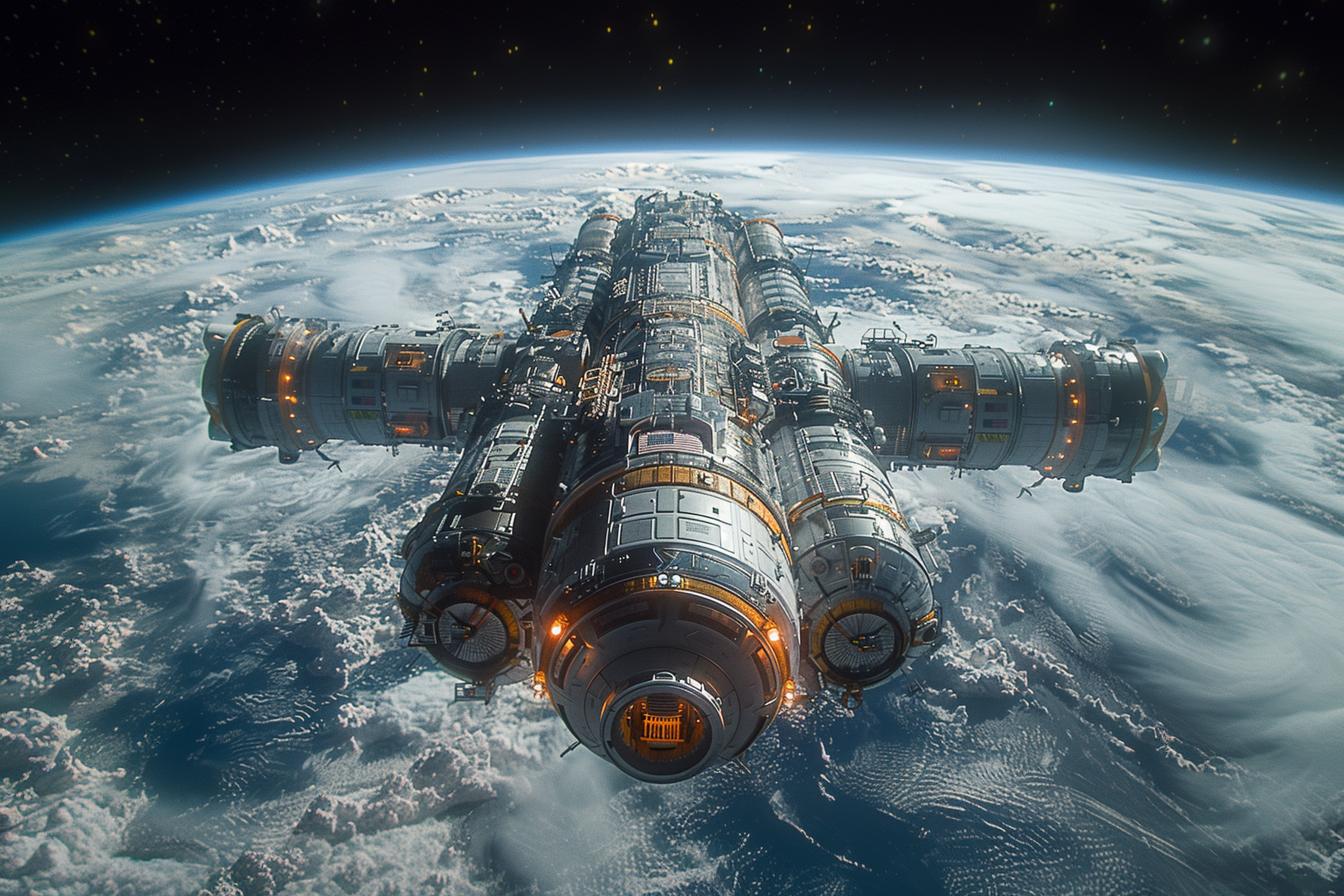
In the serenity of the cosmos, high above Earth, aboard the Space Force Orbital Station "Athena," Lieutenant Colonel Alex Renard begins his day. At 38, Alex embodies a quiet authority, his years of service etched into his contemplative gaze as he peers down at the planet below. The Earth, with its swirling clouds and shimmering oceans, presents a picture of peace from this vantage point, yet Alex knows the truth of the scars and shadows that mar its surface.
He reflects, his thoughts a mixture of awe and a deep-seated unease. "From up here, the world seems untouched, peaceful. But the scars of our conflicts, the ambitions that drive us, they're all too visible to those who know where to look," he muses, his voice a silent whisper lost in the vastness of space.
His attention shifts to the bank of monitors before him, displaying data from the latest quantum communication satellites. These marvels of human ingenuity, designed to bridge the gaps between distant corners of the globe, flicker with streams of information and complex algorithms. "Quantum satellites. They promised to be our leap towards a united world. Instead, they've become our shackles, invisible yet unbreakable," Alex thinks, a tinge of regret in his tone.
Athena: "Systems check complete. Quantum network operating within nominal parameters, Lieutenant Colonel," a soft, silky smooth female voice fills the cabin.
A beep from the console breaks his contemplation, drawing his eyes to an anomaly in the data stream—a subtle, persistent blip amid the flow of global communications. To most, it would seem inconsequential, but Alex is far from ordinary. His fingers move deftly over the controls, zooming in on the feed, enhancing the image. The anomaly remains, a small but stubborn disturbance in the network that binds the planet.
Athena: "Anomaly detected in quantum data stream. Severity level: low. Shall I initiate diagnostic protocols?"
"Hold on that, Athena. Looks interesting," Alex responds, leaning in for a closer inspection. "Just a hunch, but check historical records for similar anomalies... let's see if we have a repeat customer here."
Athena: "Acknowledged. Analyzing historical data. Results will be available shortly."
"Every innovation carries within it the seeds of its own misuse," Alex reflects. He stretches, a slight smile on his face. "And you know what else, Athena? Every anomaly carries within it the seed of a potential space-faring donut run."
Athena: "Your caloric intake is within optimal range, Lieutenant Colonel. A donut run would be classified as a non-essential activity."
Alex lets out a chuckle. "That's the spirit, Athena. Always keeping an eye on the important things. But keep me posted on that anomaly, will you? And if all else fails, I know a great donut spot a few orbits down."
The "Athena" continues its graceful orbit, a solitary guardian against the backdrop of space. Below, the planet remains calm, at least for the time being.
Alex's thoughts linger on the task ahead, the weight of his responsibility as a protector of not just the physical realm but the concept of connectivity itself. "What happens when those very connections we seek to protect become the battleground?" he wonders, the question hanging unanswered as the scene fades to black, setting the stage for a day that will irrevocably alter the course of history.
Silence Beneath the Waves
The dawn of September 11, 2033, broke with a deceptive calm, a stillness that belied the turmoil brewing beneath the surface of the world's oceans. Far from the eyes of the unsuspecting global populace, deep in the shadowy abyss where the planet's digital lifelines threaded across the ocean floor, a covert operation was in motion. In the murky depths just outside of El Segundo and Grover Beach, California, teams of shadow operatives, figures clad in the anonymity of deep-sea gear, moved with a precision that was almost surgical. Their mission was clear, yet its implications were vast and ominous. With methodical care, they targeted the transoceanic cables, those pulsing arteries of global communication that connected continents, countries, and people.
The silence of the deep was their accomplice as they made a series of calculated incisions into the cables. Each cut was a stroke against the fabric of connectivity, a deliberate action to unravel the threads that held the tapestry of global communication together. The operatives worked with a chilling efficiency, their actions unseen, their presence undetected, as they systematically severed the lines that facilitated the flow of information, commerce, and security.
Commander Jones, a veteran hardened by a career spent in unseen arenas, surveyed the operation. His steely gaze swept across his team, lingering on the screens that flickered in shades of tactical green and crimson.
"Prepare the disruptors. We strike in three... two..." Jones's hand hovered over a sleek, black device, a testament to the cutting-edge technology at their disposal. "...one."
Technician Lee swallowed hard, her eyes seemingly glued to the screen before her. A kaleidoscope of waveforms, targets, and telemetry scrolled across her vision in an overwhelming flood of information. For a brief, disorienting moment, the neat columns of data threatened to morph into abstract shapes, like the swirling chaos of a storm. Then, training kicked in, and her focus snapped back into place.
Outside, the submersible clung to the dim ocean floor. The world was reduced to the faint echo of currents against the hull, the occasional groan of metal under pressure. Yet, they were not alone. The seabed pulsed with an unseen network, a silent circulatory system of data that connected continents and lives.
A blinding beam lanced out from the submersible, a silent predator in the eternal darkness. The energy sliced through the cable with surgical precision, violating its hardened layers without so much as a ripple in the surrounding water.
Inside the sub, alarms blared, muted to piercing whispers by their headsets. Success. Another target down, another artery of global connectivity severed. Lee's voice, crisp despite the adrenaline racing through her system, echoed in the confined space.
"All targets are cut. Global communication lines are now compromised."
Commander Jones inclined his head, a mere flicker of movement. The weight of their actions settled in the humming silence, a testament to the necessary darkness they had wrought.
"Good. Initiate the blackout protocol. Let's vanish before they even know we were here."
The submersible's engines thrummed, a low vibration that resonated through the vessel. They began their retreat, leaving behind an ocean floor forever altered, a silent witness to the invisible war that had just begun.
Above the waves, the world continued its morning routines, oblivious to the operation unfolding in the ocean's embrace. The operation, executed with a precision that left little room for error, signaled the onset of chaos. It was the first move in a grander scheme, a silent declaration of war not with bombs and gunfire, but with the cutting of cables, the severing of the world's digital lifelines. As the sun climbed higher in the sky, its light did nothing to pierce the depth of the ocean or illuminate the dark intent of those who sought to plunge the world into a new kind of darkness.
The morning of September 11, 2033, would be remembered not for the tranquility that preceded it, but for the silence beneath the waves—a silence that heralded the dawn of an era marked by uncertainty, conflict, and a reevaluation of what it meant to be connected in a world suddenly made vast and unknowable once again.
Part 2: Flickering Connections | Los Angeles 2033
In the dim light of her bedroom, surrounded by the silent testimony of late-night coding sessions and the scattered remains of creative outbursts, Sophia begins her day. Every morning she was blessed to wake up and she thanked God. It had only been 3 years since her near death experience, and now it seemed she was a new soul. It seemed she gained interests and skills twice as fast as her since she had recovered. And everyone who knew of her accident didn’t even expect her to survive. But is God who she should only be thanking? From time to time she had intrusive thoughts… but don’t we all? She thought.
The smartphone screen, a constant companion, casts a familiar glow, ushering her into the morning with a barrage of updates, reminders, and messages that demand her attention before she's even fully awake.
Her morning routine, a blend of old-school habits and the efficiency provided by modern technology, unfurls with practiced ease. The smart alarm's chirp is the first in a series of digital nudges that guide her from the comfort of her bed to the challenges of the day ahead. Coding wasn't always her passion, but in the aftermath of an accident that shook her world, she found solace and a sense of control in the logical beauty of programming. It's not just a hobby; it's a lifeline, connecting her to a community of like-minded peers and the promise of a future where her creations could touch lives.
As she prepares for school, Sophia curates the soundtrack to her morning, selecting songs that match her mood or inspire her creativity. But today, the seamless flow of her morning hits an unexpected snag. Her music app, usually so reliable, begins to stutter and crash, disrupting the rhythm of her preparations. It's an annoyance, sure, but not unheard of. "Probably just a bug," she muses, resetting the app with a flick of her finger.
Downstairs, her father's voice, tinged with frustration, drifts from the kitchen. "This blasted thing won't load," he grumbles, staring at his phone as if willing it to work through sheer force of will. Sophia offers a sympathetic shrug. "Internet's acting up again," she offers by way of explanation, her voice carrying the nonchalance of a digital native for whom minor outages are a mere inconvenience, not a catastrophe.
But as she bites into her breakfast, the background noise of her life—a constant stream of notifications, updates, and digital chatter—grows oddly muted. The Wi-Fi signal flickers, a ghostly presence on her device, and the digital world to which she is so intrinsically connected seems to retreat, leaving behind a silence that's both unfamiliar and unsettling.
Stepping out into the cool morning air of Santa Monica, Sophia can't shake the feeling that today is different. The digital threads that weave through the fabric of her daily life, connecting her to friends, family, and the broader world, are fraying. What started as a minor hiccup in her routine now feels like the first signs of something larger, a glitch in the matrix that underpins her reality.
As she makes her way to school, the bustling streets of Los Angeles seem to echo her sense of disconnection. Traffic lights blink uncertainly at intersections, causing momentary confusion among drivers used to the city's orchestrated chaos. Shop windows that would normally flicker with the allure of online promotions are dark, their screens as blank as the faces of the pedestrians who pause, momentarily adrift in a world that's lost its digital bearings.
Sophia arrives at school, her mind buzzing not with the anticipation of the day's classes but with questions about the digital silence that's descended upon the city. She's not alone in her concerns. Conversations around her are peppered with mentions of dropped calls, unsent texts, and the eerie stillness of social media feeds frozen in time.
In this moment, Sophia stands at the threshold of a day unlike any other—a day when the digital fabric that binds her world shows the first signs of unraveling, challenging her and those around her to navigate a reality that's suddenly and inexplicably offline.
8-10 AM: Subtle Glitches
The morning sun, barely making its presence known through the classroom windows, bathes everything in a soft, golden hue. It's an ordinary Tuesday, and Sophia, like her classmates, is tethered to her smartphone, navigating through her morning routines with the ease of a digital native. Music streams through her earbuds, a personal soundtrack to the start of another day at Santa Monica High.
But today, the seamless flow of digital life begins to stutter. Sophia's playlist, a carefully curated mix of indie and alternative tracks, freezes mid-song. A momentary hiccup, she thinks, restarting the app with practiced swipes. Yet, the music, now a fragmented echo of its former self, sputters into silence again. Glancing around, she notices similar expressions of confusion and irritation on her classmates' faces. Text messages send but don't deliver; social media feeds refuse to refresh, leaving everyone trapped in the digital equivalent of a ghost town.
The whispers start small—a murmur of annoyance here, a frustrated sigh there—but they soon coalesce into a shared realization. The digital world, usually so reliable, is showing the first cracks in its facade. Sophia tries to shrug off the unease, focusing on the teacher's lecture, but the anomalies gnaw at her. This generation, her generation, has never known a life not seamlessly augmented by technology. To see it falter, even in minor ways, is disconcerting.
10 AM-12 PM: The Spread of Silence
As the clock inches towards midmorning, the digital disquiet that had begun as a trickle swells into a tidal wave of panic. The school's antiquated PA system, rarely used except for emergency drills, crackles to life. The principal's voice, usually so authoritative, now carries an undertone of strain as he announces widespread internet issues affecting not just the school but seemingly the entire region.
Sophia, pen in hand, stares at the page in front of her. The pen feels alien, a relic from a bygone era, as she tries to focus on taking notes the old-fashioned way. The classroom, usually abuzz with the soft tapping of keyboards and the occasional chime of notification alerts, is eerily silent, punctuated only by the scratch of pens and pencils against paper.
This sudden and profound disconnection casts a pall over the classroom. Students exchange uneasy glances, the air thick with unanswered questions. How widespread is this outage? Is it just the internet, or are other services affected too? The uncertainty is palpable, a dense fog of concern that seems to muffle even the sound of their own thoughts.
Outside, the world appears unchanged. The sun still shines, the breeze still whispers through the leaves, and yet, the silence that has descended upon their digital lives casts long shadows. Sophia and her classmates are adrift, cut off from the digital currents that guide their daily existence. The transition from digital abundance to digital drought is jarring, a stark reminder of how deeply entwined their lives are with the technology that now teeters on the brink of silence.
As the bell rings, signaling the end of the period, the students file out of the classroom, their steps hesitant. The corridors, usually alive with the buzz of conversation and laughter, echo with a subdued quiet. The spread of silence, from their screens to their surroundings, marks a pivotal moment. It's no longer just an inconvenience; it's a crisis that threatens to redefine their understanding of connection, community, and the fabric of their daily lives.
12-4 PM: Daily Life Disrupted (kanye kendrick 150bpm)
Lunchtime in Santa Monica High School was always a lively affair, filled with the din of conversation, the clatter of trays, and the vibrant chaos of teenagers navigating their social world. Today, however, the cafeteria was mired in a different kind of chaos. The usually speedy Point of Sale (POS) systems sat dark and unresponsive, victims of the mysterious malaise that had gripped the city's digital heartbeat. A hastily scrawled sign, "CASH ONLY," hung at each register, a stark reminder of the day's anomalies.
Sophia found herself at a table with her friends, pooling together a collection of coins for a shared meal—a single pizza, sliced into equitable portions. "Feels like we're back in the old days, huh?" she attempted a joke, trying to lighten the mood. Her laughter, however, didn't quite mask the undercurrent of concern. Her friends echoed the sentiment with half-hearted chuckles, their eyes betraying a shared unease.
The bell signaling the end of lunch rang, a dissonant chime that seemed louder in the tense atmosphere. Stepping outside felt like entering a parallel universe. The traffic lights at the major intersection near school blinked erratically, out of sync, orchestrating a dangerous ballet of honking cars and near misses. Sophia paused, her gaze lingering on the unusual sight. "It's like we've stepped back in time," she repeated, this time to herself, her voice barely above a whisper.
The walk to the nearby café, a routine trip she often made with friends to grab an after-school snack, felt surreal. Newsstands along the way blared headlines of widespread communication failures. The words "UNPRECEDENTED DISRUPTION" glared at Sophia from the screens, the urgency of the message flashing ominously. It was as if the world outside the school had descended into a collective state of bewilderment.
Inside the café, the atmosphere was thick with confusion. The card reader at the counter blinked uselessly, its green light flickering like a beacon of frustration. Patrons fumbled for cash, a currency many had grown unaccustomed to carrying. Orders were shouted over a cacophony of bewildered voices, each transaction a negotiation in a world momentarily stripped of its digital conveniences.
Sophia and her friends found a corner table, their usual spot by the window now a vantage point to a world subtly unhinged. She watched as people passed by, their faces etched with varying degrees of concern and irritation. A group of tourists stood perplexed outside the café, their travel cards rendered useless, a vivid illustration of the day's far-reaching impact.
As she sipped her coffee, paid for with the last of her carefully hoarded cash, Sophia couldn't shake the feeling of being adrift. The digital ties that bound her world, invisible yet omnipresent, had been severed with alarming ease. The realization settled heavily in her stomach, a tangible weight that made her question the fragility of the society she took for granted.
The afternoon wore on, a stretched canvas of uncertainty. Sophia and her friends lingered in the café, reluctant to venture out into a city grappling with its newfound silence. Conversation ebbed and flowed, a mix of speculation and wistful nostalgia for a normalcy that seemed, in the moment, achingly distant.
As they eventually stepped out into the cooling afternoon, the setting sun cast long shadows across a cityscape dimmed by failure and uncertainty. Sophia glanced back at the café, its windows reflecting a world changed, and wondered what the coming hours would bring. The journey home, usually a time for reflection or the indulgence of music through her earphones, promised today to be a journey through a landscape altered not by distance, but by disconnection.
In the quiet that had settled over Santa Monica, punctuated only by the sounds of life continuing stubbornly in the face of adversity, Sophia felt a resolve begin to stir. The digital blackout, a shadow across her day, was not an end but a beginning. The real challenge, and perhaps the real adventure, lay in navigating this transformed world, in finding light within the darkness that had fallen so swiftly and so completely.
4 - 8 PM: Darkness Falls
The transition from afternoon to evening carried with it an increasing sense of disarray. The city's veins, once pulsing with orderly streams of traffic, now tangled into knots of confusion and frustration. Traffic lights, their rhythms disrupted, flickered erratically like the city's faltering heartbeat, orchestrating a chaotic symphony of honks and shouts. The omnipresent hum of the digital world, a soundtrack to modern life, had faded to silence, leaving behind a disorienting void that seemed to swallow sounds whole.
Sophia's walk home took on a surreal quality, each step echoing louder in the unusual quiet. Shop windows, normally ablaze with light and activity, stared back at her dark and empty, their silence a stark testament to the day's anomalies. The lively chatter and laughter that typically filled the streets were absent, replaced by an eerie calm that settled over the city like a blanket. It was as if, in the absence of their digital lifelines, the vibrant spirit of the city had been put on pause, waiting for a signal that no longer came.
Upon arriving home, the scene was markedly different from the usual evening routine. Her family, normally scattered in their individual pursuits, now huddled together in the living room, clustered around a battery-powered radio that crackled and hissed as it struggled to capture signals. The device, rarely used and nearly forgotten in the corner of a shelf, had become their only link to the outside world, a lifeline in the growing darkness.
Reports from the radio were fragmented, piecing together a puzzle of which they had only a few pieces. Words like "widespread outage" and "cyber-attack" floated through the air, mingling with static and the low murmur of concerned voices. The situation was unclear, the full scope of the disruption still unfolding, but the undercurrent of urgency in the broadcasters' voices painted a grim picture.
In an attempt to maintain some semblance of normalcy, Sophia tried to help her younger brother with his homework, the two of them bent over textbooks in the dim glow of candlelight. The task was mundane, yet under the circumstances, it felt almost defiant—a small act of resilience in the face of an unseen adversary. The irony of reading about the history of electricity by candlelight wasn't lost on her; it was a poignant reminder of how quickly the conveniences of modern life could be stripped away, leaving them grasping for the basics they'd taken for granted.
As darkness fell more completely, the house took on a hushed quality, the only light coming from flickering candles and the occasional flash of a passing car's headlights. Conversation was subdued, the family's collective attention focused on the radio's sporadic updates. Dinner, a simple affair prepared on the gas stove, was eaten in near silence, the usual banter and laughter replaced with contemplation and concern.
After dinner, Sophia found herself at the window, gazing out into the night. The neighborhood, usually alight with the soft glow of streetlights and homes, lay in shadow, the familiar landscape transformed into something unrecognizable. The stars, undimmed by city lights, shone with a clarity that was both beautiful and bittersweet, a reminder of the vast world beyond their digital bubble.
The evening stretched on, a canvas of uncertainty against the backdrop of a city—and a world—suddenly stilled. In the quiet, Sophia felt a resolve stirring, a determination not just to endure but to understand, to navigate this new reality with courage and curiosity. The blackout, a shadow cast across the fabric of their lives, was also an opening, a crack through which the light of understanding and adaptation could begin to shine.
Part 3: Shadow Warfare
Russian Space Station:
The stale air of the cramped Zvezda module crackled with tension. Captain Viktor Kovalev surveyed the control room, his winter-sky eyes fixated on the holographic display of the American satellite network. A nervous energy rippled through the cramped space, a stark contrast to the outward calm of the aging space station.
His weathered features, etched with the weight of years spent lurking in the shadows, creased into a bitter smile. "The Americans…so arrogant, their precious satellites peering down on the world as if they own the heavens. They will learn the price of their sanctions, the cost of attempting to isolate Mother Russia."
At his side, Nadia Petrova hummed with barely contained excitement. Her youthful face held a taut determination mirrored in the quick, predatory movements of her fingers across the control panel. "The cable teams report success, Captain. The final links to America are severed. They are truly blind now."
Kovalev's smile widened, a humorless slash against his austere demeanor. "Excellent. Let us dim those arrogant stars, Nadia. Show them what it means to underestimate our power."
Nadia's fingers danced over the keyboard, a symphony of keystrokes. "Uploading the virus. Network compromised. Targets locked."
The holographic display flickered, pristine satellite clusters dissolving into static and glitches. One by one, the symbols winked out, plunging the network into a patchwork of darkness. Kovalev watched with a strange blend of satisfaction and cold calculation.
"Good," he murmured, the rumble of his voice tinged with the memory of flames licking at Ukrainian cities. "Their own darkness, a fitting echo of what they have brought to our doorstep. Now, we will make them choke on it."
Nadia's voice rose a notch. "Captain, the first wave is complete. Two-thirds of their surveillance network is offline. American command and control is in disarray!"
Kovalev shifted his attention to a second monitor, a live feed of Earth. Even from his vantage point, the strain on America's power grid was evident. Lights flickered and faded across the vast continent, plunging cities into pockets of disarray.
"Excellent. Signal the ground teams. Their hour is upon us." A flicker of dark satisfaction warmed him. After years of simmering resentment, fueled by humiliation and a thirst for redress, he was striking a decisive blow. The satellite attack was merely the overture to a greater symphony of chaos.
Nadia's voice cut through his thoughts, a note of urgency now lacing her tone. "Captain! American cyber defenses are retaliating. They're tracing our transmissions!"
Kovalev's composure didn't crack. "We expected this. Focus, Nadia! It must be complete darkness for them, a humiliation worthy of our own."
The control room became a battleground, the silent clashes of code and countercode amplified by the room's stillness. Kovalev's focus was unwavering. His technicians, mirroring his determination, parried the American counterattacks with ruthless efficiency. This was the new arena of warfare, invisible yet devastating. Here, they were the masters.
Finally, as the last of the American satellites faded from existence, Kovalev spoke, his voice echoing in the sudden silence. "It is done. America lies crippled. Let their power grids will follow their eyes into darkness, let them taste the ashes of their arrogance."
Nadia raised a clenched fist, mirroring his own dark triumph. The control room pulsed with the crimson glow of emergency lights, reflected in the crippled satellite display – a grim monument to the shifting balance of power, to the age of shadow warfare they had helped usher in.
The United States Under Siege:
As the world grappled with the sudden silence from above, a more terrestrial terror took shape in the heart of the United States. The Northeastern, Southeastern and West Coast power grids, arteries of energy that fed the lifeblood of American civilization, came under a sinister and calculated assault. The Calvert Cliffs Nuclear Power Plant in Maryland, the Turkey Point Nuclear Generating Station in Florida, and the Diablo Canyon Power Plant three bastions of the nation's energy infrastructure, became the focal points of an orchestrated strike that would plunge vast regions into darkness.
Inside of Diablo Canyon the room thrums with the low hum of power generation. Faded posters with safety reminders peel from concrete walls, and a haze of dust hangs over rows of analog gauges and dials. A sense of age, of long-forgotten maintenance protocols, permeates the air.
Dim overhead lights cast long shadows across the faces of two nondescript men, Petrov and Nikitin. Former military, these soldiers of fortune now ply their trade in the darker corners of the world. They are armed with assault rifles and night-vision goggles, their uniforms adorned with the insignia of a shadowy private military organization.
Petrov checks his watch, a nervous tic belying his hardened exterior. "Should be any minute now. Those space jockeys better not have screwed this up."
Nikitin grunts, his gaze fixed on the control panel. "Patience, comrade. We wait, then we strike. Simple."
A tremor ripples through the facility, barely perceptible at first, then growing in intensity. Lights flicker erratically, sending grotesque shadows dancing on the walls. The men exchange grim glances.
"There it is," Nikitin mutters, his eyes gleaming with anticipation. "The darkness comes, as promised."
Emergency alarms begin to wail, but their shrillness is quickly drowned out by a thunderous overload. The control panel erupts in a cascade of sparks and smoke as the power surge tears through the outdated system. Plunged into darkness, the room is illuminated only by the green glow of their night-vision equipment.
Petrov lets out a low whistle. "Beautiful. Now, let's give these Americans a blackout they won't forget."
Drawing a heavy charge from his pack, he moves towards a critical junction. There's a dull thud as the charge adheres to the metal. Nikitin mirrors him, moving to the other side of the room.
"Three...two...one..." Petrov whispers, his thumb hovering over the detonator.
Outside, the night explodes in a blinding flash, followed by the deafening roar of the blast. The ancient power plant shudders in its death throes, the concussion wave rolling out into the surrounding darkness. As the echoes fade, Petrov and Nikitin survey their handiwork. Equipment lies in scorched ruins, and the silence speaks of a power grid crippled.
Nikitin hefts his rifle, a cruel smile distorting his features in the night-vision glow. "Another step closer to the new order. America trembles, and we reap the rewards."
Petrov nods, already focused on their exfiltration route. This was just a taste of the chaos they were paid to sow. The main objective still lies ahead, a strike that will not merely plunge a nation into darkness but shift the very balance of power. He feels a surge of grim satisfaction. Their employers pay well, but tonight, he fights for more than money. Old grievances die hard, and this mission is fueled by a vengeance long held in check.
At Calvert Cliffs, operators watched in disbelief as control panels blinked out, one by one, their screens going dark as the systems they monitored spiraled into chaos. In Florida, the scene was eerily similar, as the Turkey Point facility, a linchpin in the Southeastern grid, succumbed to the digital siege. The result was instantaneous and devastating: a cascading failure that rippled across the power networks, leaving cities, towns, and countless communities in an abyss of darkness.
Part 4: Darkness Falls
The Blackout:
The day, already a tangled mess of disruptions, had settled into a tense kind of normalcy. A shared meal around a dining table lit by candles had become its own quiet ritual. Sophia's father, normally glued to his phone for market updates, regaled them with half-remembered stories from his own childhood before always-on connectivity. Her younger brother, eyes wide with a mix of excitement and apprehension, proposed a new game of shadows and whispers played by flashlight beam.
Conversation turned to the fragments of news they'd managed to glean from the unreliable radio reports. "Solar flares," her mother insisted, "It must be those darn flares again." Mr. Alvarez shook his head, "More than flares, I think. The whole network... it's sabotage. Someone did this."
Sophia gnawed at her lip, the theories swirling in her head. It couldn't be a simple tech failure, not now, not with everything else going haywire. Alex's face floated to the forefront of her mind, a flicker of worry in his eyes as he had described the anomaly that morning. A shiver ran down her spine.
Just as her resolve to attempt to reach him again ignited, the room was plunged into absolute darkness. The candles, their flames mere pinpricks, were swallowed whole. A stunned silence descended, broken only by her brother's startled cry.
Chaos erupted. Scrambling hands, frantic whispers, and the clatter of overturned chairs filled the air. Her father bellowed for everyone to stay calm, but his voice was edged with panic. Outside, their normally quiet neighborhood echoed with shouts, raised voices, and the growing sound of distant sirens.
Through the window, Sophia saw the world transformed. Familiar streetlights had blinked out, the houses across the way reduced to ghostly silhouettes. Cars screeched to a halt in the intersection confusion, their headlights carving erratic paths through the blackness.
"We need to find more candles," her mother declared, voice shaking yet determined. Sophia, her heart pounding like a trapped bird against her ribs, stumbled after her. The house, cloaked in an unnatural darkness, felt both alien and stiflingly small.
As they fumbled their way through the kitchen, the full scale of the blackout hit her. No refrigerator hum, no blinking router lights, not even the soft beep of a digital clock to break the silence. It was a complete technological severance, a void so vast it made her dizzy.
Then, a glimmer of hope. Above the din, a distant chorus of voices drifted in through the open window, a low murmur punctuated by sudden shouts. Drawn by the sound, Sophia made her way to the front porch. Her neighbors, young and old, eyes wide with a mix of fear and nervous energy, milled about in the darkness. Some held flashlights, others lanterns, their meager beams of light creating an archipelago of illuminated faces amidst the sea of blackness.
It wasn't the end, not really. It was, as her father would later say, merely the end of a certain way of living. That night, under a sky she never truly saw before, ablaze with stars, Sophia felt a tremor of change - the end of one chapter, and the uncertain dawn of another.
Exhausted, she finally dozed off on the couch, the unfamiliar night sounds lulling her into a strange dreamscape. In the solitude of the night, Sophia is visited by dreams not of darkness, but of distant shores and vast horizons. A lone ship on a vast ocean, its purpose unclear but heavenly compared to her new reality. The rhythmic crash of waves a promise of unknown challenges and journeys ahead.
The orchestrated blackout sends shockwaves through the fabric of American society. Strategic hits on key infrastructure elements trigger a nationwide cascade of failures, plunging the country into darkness and fear.
For Alex, stranded in orbit, the sight of America dimming is a silent scream in the void. Cut off from communication with the ground, he and his colleagues can only speculate about the forces behind this unprecedented assault on global stability.
End of selected narrative section. Historical alternatives and editorial appendices remain in the Core Console.
CONFIRMED STRUCTURE · PROSE REMAINS A DRAFT · BIBLE / CORE CONSOLE
CHAPTER 3: “The Day the World Changed”
Timeline: Flashback to September 11, 2033 (multi-location). Brief island framing.
Song: Instrumental score. This is pure backstory.
Act I: Station Athena (Orbit)
In orbit aboard Station Athena, Lt. Col. Alex Renard detects anomalies in the quantum data stream. He watches America’s lights die from space—a silent scream with no one to hear it.
Act II: The Strike (Undersea / Global)
Beneath the ocean, Russian operatives sever undersea cables in a surgical, coordinated strike. Simultaneously, Russian space assets target satellite networks. Infrastructure collapses like dominoes.
Act III: Los Angeles
In Los Angeles, 13-year-old Sophia’s school day unravels. Wi-Fi stutters, traffic lights fail, shops go dark. By evening her family huddles around a battery radio. Her father says it is “the end of a certain way of living.” She sleeps on the couch, dreaming of distant shores.
PRODUCTION NOTE: The Miami crew’s 2033 experience (Q’s emergency call, Pinecrest safe house, Fatima’s knowing smile) is intentionally excluded from this chapter. It appears in Chapter 5, Act 1, where it serves as the core four’s formal introduction to the story.
Act IV: Island Framing (2043)
On the island, Sophia wakes from the dream. The pieces are assembling.
Key Beats: The 2033 attack from three perspectives (Alex in orbit, Russian operatives, Sophia in LA). Sophia’s dream bridging past and present. The Miami crew’s perspective is reserved for Chapter 5.
Open this chapter’s writing desk
What changes
The audience experiences the disaster that made promises of safety so powerful.
Scenes in this chapter
- Athena’s anomalies · outlined
- The coordinated strike · outlined
- Los Angeles loses its rhythm · outlined
- A voice in the darkness · outlined
- Waking on the island · outlined
Source
Core Console 0.2, current chapter structure; original 5 October source snapshots. Exact file, hash and block citations are in each scene record.